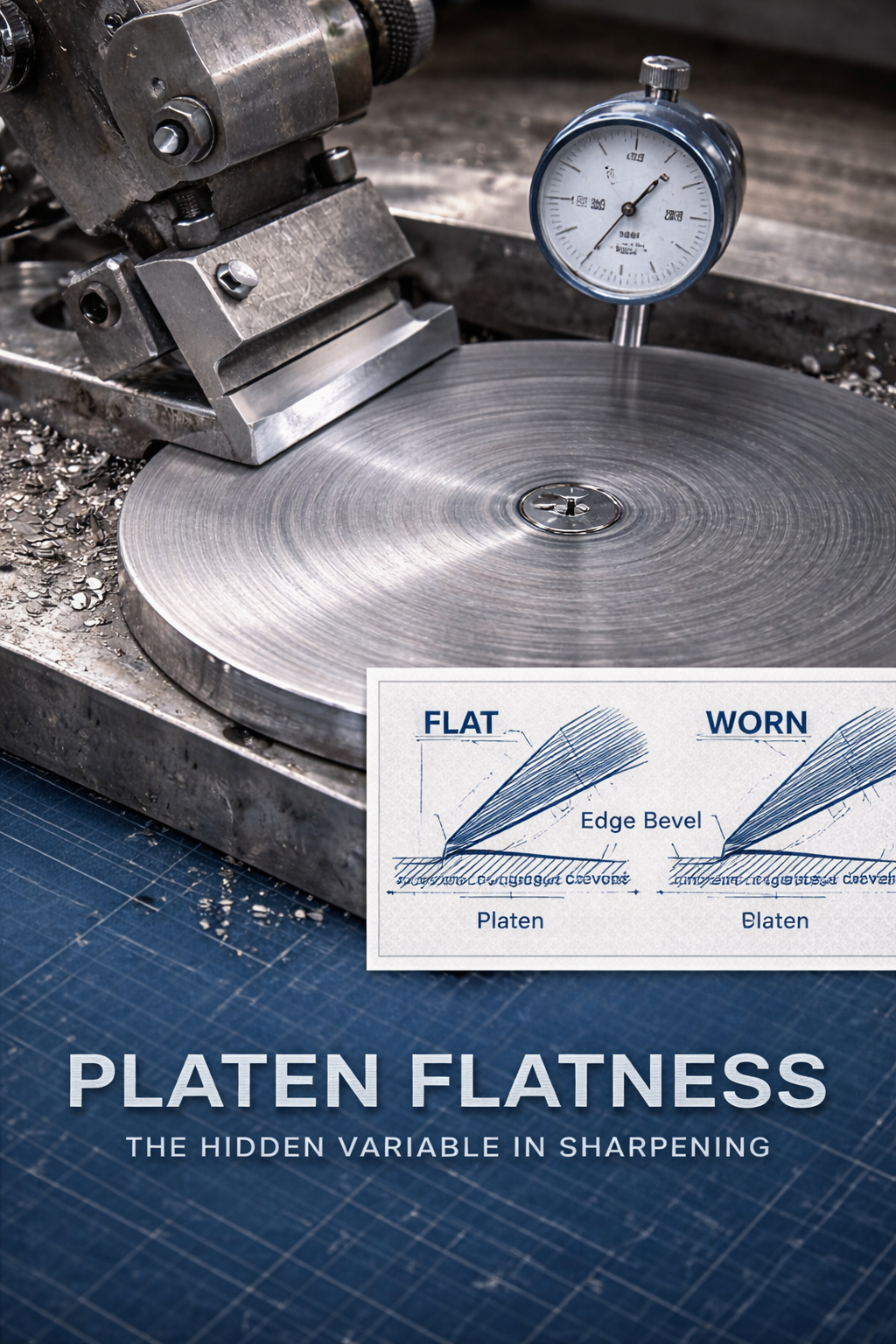
Platen Flatness: The Hidden Variable in Sharpening
In professional sharpening, platen flatness is often assumed rather than verified.
That assumption is one of the most common sources of long-term tool damage.
A platen does not need to appear flat to affect results.
It only needs to be slightly wrong.
This post explains why platen flatness is a hidden variable in sharpening, how minor deviations compound into major geometry errors, and why professional processes must treat platen condition as a controlled parameter—not a background detail.
Flat Is Not a Visual Condition
A platen can look flat and still be functionally compromised.
Visual inspection fails because:
The human eye cannot detect micro-deviation
Wear patterns develop gradually
Surface distortion often occurs evenly, not obviously
Flatness is a measured condition, not an observed one.
In sharpening, even minute deviations alter how the edge engages the surface, how pressure is distributed, and how material is removed.
How Platen Deviation Alters Edge Geometry
The edge bevel is not defined by intent.
It is defined by contact geometry.
When a platen is not flat:
Contact occurs unevenly
Pressure concentrates unintentionally
The bevel angle changes without adjustment
Material removal becomes asymmetrical
These effects are subtle per pass but cumulative over time.
What appears to be an edge problem is often a surface problem expressed through the edge.
Convexity, Concavity, and Drift
Platens do not fail uniformly.
Common deviation patterns include:
Center wear creating concavity
Edge wear creating convexity
Directional drift caused by repetitive motion
Thermal distortion under repeated friction
Each pattern produces a different bevel outcome, none of which align with intended geometry.
Without verification, technicians compensate unknowingly—altering technique to chase results that the surface itself is preventing.
Why Compensation Is Not Control
Experienced technicians often adapt instinctively to surface drift.
This is not mastery — it is workaround behavior.
Compensation:
Masks the underlying issue
Increases variability between technicians
Makes outcomes non-repeatable
Accelerates cumulative steel loss
A process that relies on compensation instead of correction is unstable by definition.
Flatness as a Process Variable
In a controlled sharpening environment, platen flatness must be treated as:
A variable subject to drift
A condition requiring verification
A component with a service lifecycle
Ignoring platen condition introduces uncontrolled error into every subsequent step.
No amount of skill can override a faulty reference surface.
Verification Over Assumption
Professional sharpening processes do not assume flatness — they verify it.
Verification:
Establishes a known reference
Reduces hidden variability
Preserves geometry over multiple service cycles
Protects steel integrity long-term
Without verification, consistency is coincidental.
Institutional Standard
The platen is not a passive component.
It is the geometric authority in the sharpening process.
If the platen is compromised, every edge produced on it inherits that compromise.
Platen flatness is not an optional concern or a maintenance footnote.
It is a foundational requirement for any process claiming professional legitimacy.
Surface integrity begins with a true surface.
Everything else follows.