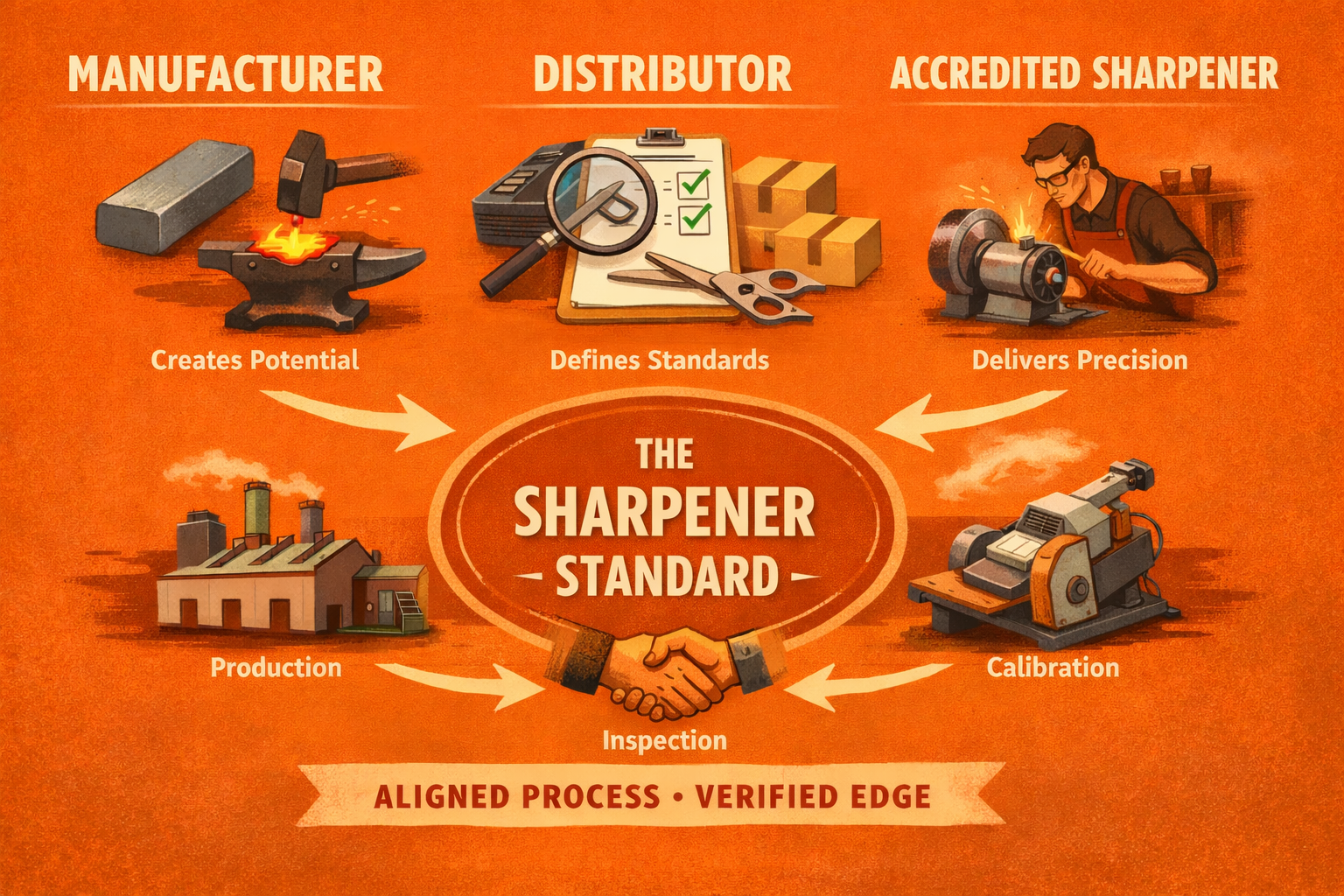
Country of Origin Claims: How Quality Is Actually Delivered
Country of origin is often treated as a proxy for quality.
In professional tool work, that assumption breaks down quickly.
A long-lasting, reliable edge is not created by geography alone. It is the result of aligned responsibility across manufacturing, distribution, and accredited processing.
This article explains why country of origin claims must be understood in context—and why true quality emerges only when manufacturers, distributors, and accredited sharpeners operate to a shared standard.
Manufacturing Creates Potential, Not Completion
Manufacturers define what a tool can be.
They determine:
Steel selection
Heat treatment capability
Baseline geometry
Production tolerances
Even at high levels of craftsmanship, manufacturing outputs exist within ranges, not absolutes. A new shear leaving a factory is a candidate for professional performance—not a guarantee of it.
Manufacturing establishes potential.
It does not finalize readiness.
Distribution Defines What Reaches the Professional
The distributor is the first filter after manufacturing.
This role determines:
Which production runs enter a market
What tolerances are accepted or rejected
Whether tools are inspected, corrected, or passed through untouched
When distributors operate to an accredited standard, they do more than move inventory. They enforce selection discipline and ensure that only tools meeting defined criteria reach professionals.
This makes distribution a quality-defining layer, not a logistical one.
Country of Origin Is Fragmented by Reality
A single country label obscures the actual production chain.
A shear may involve:
Steel sourced from one region
Manufacturing in another
Finishing elsewhere
Final inspection—or lack of it—at distribution
None of these steps alone define excellence.
Quality emerges only when each step is aligned and verified.
Accredited Sharpening Completes the Process
A new shear is not finished when it is sold.
It is finished when it is verified and calibrated.
An accredited sharpener, using accredited equipment, ensures:
Geometry is correct, not assumed
Pivot systems are stable
Surface integrity is preserved
Heat and friction are controlled
The edge is engineered for longevity, not first impression
This step transforms potential into performance.
Where the Standard Actually Lives
A durable, professional edge is the conversion point where all of these elements meet:
Capable manufacturing
Disciplined distribution
Accredited sharpening
Verified equipment
Defined acceptance criteria
Remove any one of these, and quality becomes inconsistent.
Country of origin may describe history.
Standards describe outcomes.
Institutional Sharpening Standard
The highest probability of receiving a reliable, long-lasting professional tool occurs when:
The manufacturer produces within disciplined parameters
The distributor enforces independent acceptance standards
The sharpener applies accredited processes using calibrated equipment
Quality is not delivered by geography.
It is delivered by alignment.